

 返回博客
返回博客How One Video Giant Maintained 0.1ms Latency at 200K QPS
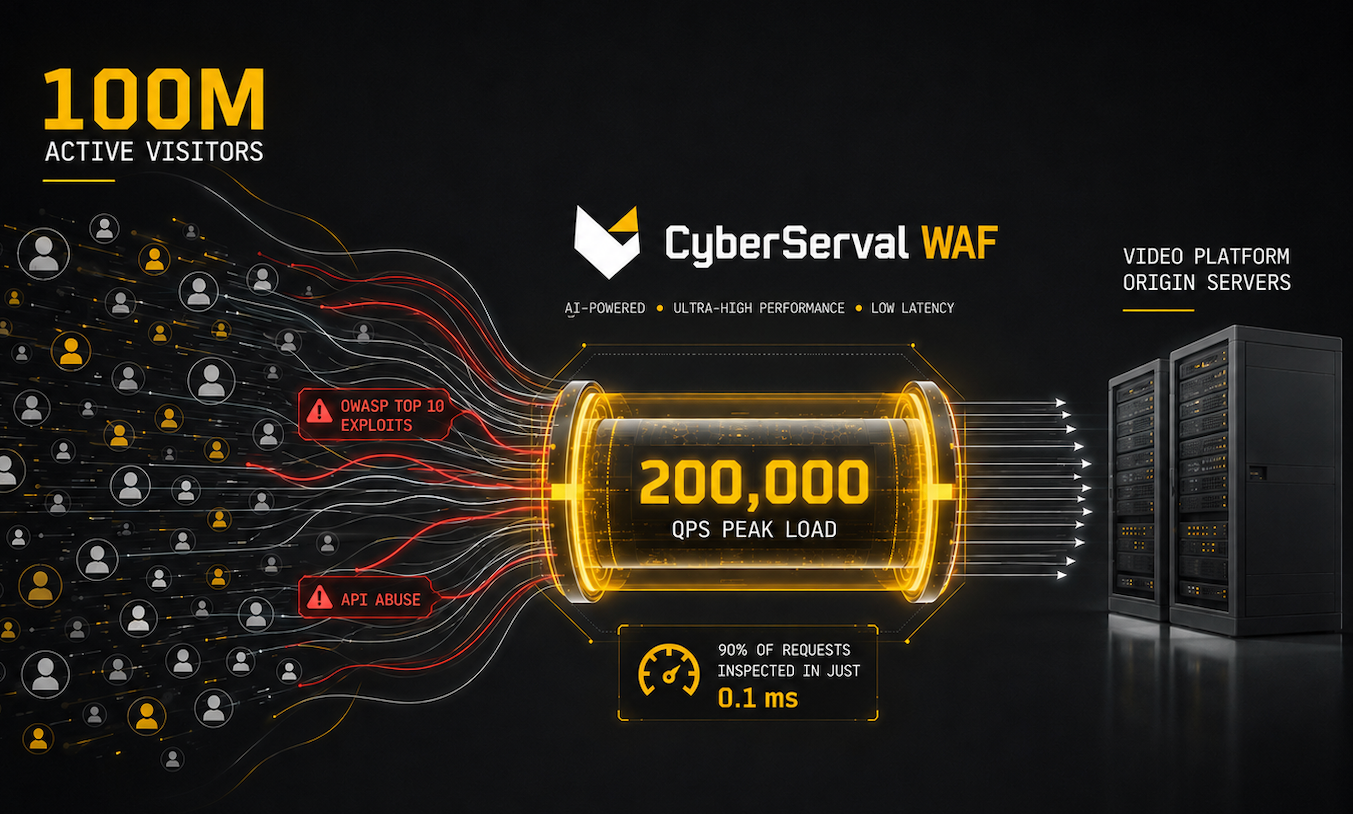
A top-three video streaming platform with massive concurrent infrastructure manages an exceptionally high-volume digital ecosystem, averaging over 100 million daily active visitors (DAV). On a regular operational day, its distributed architecture processes billions of inbound HTTP/HTTPS requests.
During a high-profile live broadcast event, user authentication, chat rooms, and API endpoint activity escalated simultaneously, driving web traffic to a critical peak of 200,000 Queries Per Second (QPS). This extreme volumetric expansion pushed network equipment and application servers to their computational boundaries. In these ultra-large traffic environments, malicious actors frequently mask advanced application-layer attacks—such as automated credential stuffing, API abuse, and slow-rate Distributed Denial of Service (DDoS) exploits—within legitimate user traffic. The platform needed an enterprise-grade Web Application Firewall (WAF) capable of inspecting massive transaction volumes with ultra-low latencies, ensuring that stringent security compliance did not introduce service degradation or system crashes during maximum resource saturation.
Why Do Legacy Signature-Based WAFs Fail Under Massive Volumetric Loads?
When application layer traffic scales exponentially, traditional regex-matching network appliances face an architectural breakdown known as "rule explosion." High QPS environments expose several fatal systemic vulnerabilities in legacy egress protections:
| High-Traffic Security Challenge | Limitations of Standard Inspection Engines | Impact on High-Volume Media Infrastructure |
| High-Latency Deep Packet Inspection | Linear evaluation of thousands of complex regular expression (regex) signatures creates processing queues. | Increases request latency, leading to video buffering and dropped user sessions. |
| Resource Exhaustion Under Stress | Complex pattern matching demands intense CPU cycles when parsing nested HTTP payloads or JSON APIs. | Triggers full CPU saturation (100% CPU utilization), forcing appliances to crash or drop traffic. |
| Fail-Open Security Blind Spots | Legacy systems frequently trigger emergency "fail-open" bypass modes to preserve website uptime during traffic spikes. | Leaves the entire application layer completely unprotected against targeted OWASP Top 10 exploits. |
| DDoS vs. Legitimate Traffic Blending | Inability to distinguish between flash crowds and volumetric application-layer attacks without static rate-limiting. | Blocks legitimate paying subscribers while failing to stop distributed, low-and-slow exploit payloads. |
How Did CyberServal WAF Protect Infrastructure Vitality at 100% CPU Saturation?
To survive the extreme demands of the live broadcast event, the streaming platform deployed CyberServal WAF as its core inline security enforcement layer. The system utilized high-performance algorithmic intelligence to remain fully operational while other infrastructure components reached maximum compute thresholds.
- Deterministic Processing via Algorithm-Based Threat Detection
Instead of matching inbound payloads against an ever-growing database of static regex rules, CyberServal WAF implements proprietary algorithm-based threat detection. By converting tokenized HTTP elements into deterministic mathematical matrices, the inspection execution path remains constant regardless of the payload complexity or threat type. This algorithmic approach minimizes architectural overhead, enabling the platform to extract maximum threat-filtering utility using minimal hardware resource allocations.
Related Article: From Rule-Based WAF to Semantic Intelligence WAF
- Ultra-Low Processing Latency for Seamless Content Delivery
In large-scale content delivery networks, every millisecond of security processing delay compounds into visible latency for the end user. CyberServal WAF maintains an ultra-low latency profile, processing 90% of all incoming HTTP/HTTPS requests within a swift 0.1 ms response window. This sub-millisecond execution ensures that even at a sustained scale of billions of daily requests, the threat detection pipeline introduces no perceptible lag to live streams, API calls, or transactional database queries.
- Uncompromised Stability
During the peak of the live event, concurrent user connections caused the system's core host infrastructure CPU consumption to spike to 100%. Under these exact conditions, standard security appliances typically experience kernel panics, freeze, or auto-bypass inspection. CyberServal WAF stood as the sole survivor of the infrastructure series, maintaining continuous packet inspection and actively blocking application exploits without a single crash or packet drop despite full CPU saturation.
Tangible Business Value Delivered by Resilient Architecture
CyberServal WAF successfully turned an extreme infrastructure stress test into a validation of robust enterprise security:
Absolute Service Continuity: The platform maintained 100% web application availability for its 100 million daily visitors, preventing the costly financial and brand damage associated with broadcast outages.
Algorithmic Efficiency: The deployment proved that high-performance threat filtering does not require massive, expensive hardware expansion, operating with high resource efficiency even during peak 200,000 QPS demands.
Zero-Bypass Security Assurance: By surviving full compute saturation without defaulting to a vulnerable "fail-open" state, CyberServal WAF guaranteed uninterrupted protection when the streaming platform was at its most vulnerable.